Introduction
Mohammad Abdullah Hashrouf is an Occupational Health and Safety Specialist dedicated to promoting safe, healthy, and productive workplaces. His professional focus is centered on preventing workplace incidents, identifying and controlling hazards, supporting regulatory compliance, and developing a strong safety culture among employees and contractors. Through practical site-based safety management, toolbox talks, inspections, risk assessments, and workforce engagement, he contributes to creating work environments where safety is treated as an essential part of every operation.
Working in occupational health and safety requires more than simply identifying unsafe conditions. It requires communication, leadership, observation, technical knowledge, and the ability to encourage workers and supervisors to make safe decisions. Mohammad Abdullah Hashrouf approaches safety with this practical mindset, focusing on prevention and continuous improvement.
Mohammad Abdullah Hashrouf Professional Focus
As an Occupational Health and Safety Specialist, Mohammad Abdullah Hashrouf is involved in monitoring workplace activities and ensuring that safety requirements are understood and followed. His responsibilities can include conducting site inspections, identifying hazards, communicating control measures, supporting risk assessments, and following up on corrective actions.
A key part of his professional approach is being present where work is taking place. Construction and industrial environments can involve multiple simultaneous activities, including lifting operations, work at height, equipment movement, material handling, installation activities, hot work, and use of access equipment. Each activity can introduce different risks. Effective safety supervision therefore requires continuous observation and communication.
Mohammad focuses on identifying potential hazards before they develop into incidents. This preventive approach includes checking working conditions, equipment, access routes, personal protective equipment, exclusion zones, housekeeping, and compliance with established safe work procedures.
Commitment to Workplace Safety
A strong safety professional understands that workplace safety is a shared responsibility. While safety specialists provide guidance and monitoring, every worker, supervisor, engineer, and manager has an important role in preventing incidents.
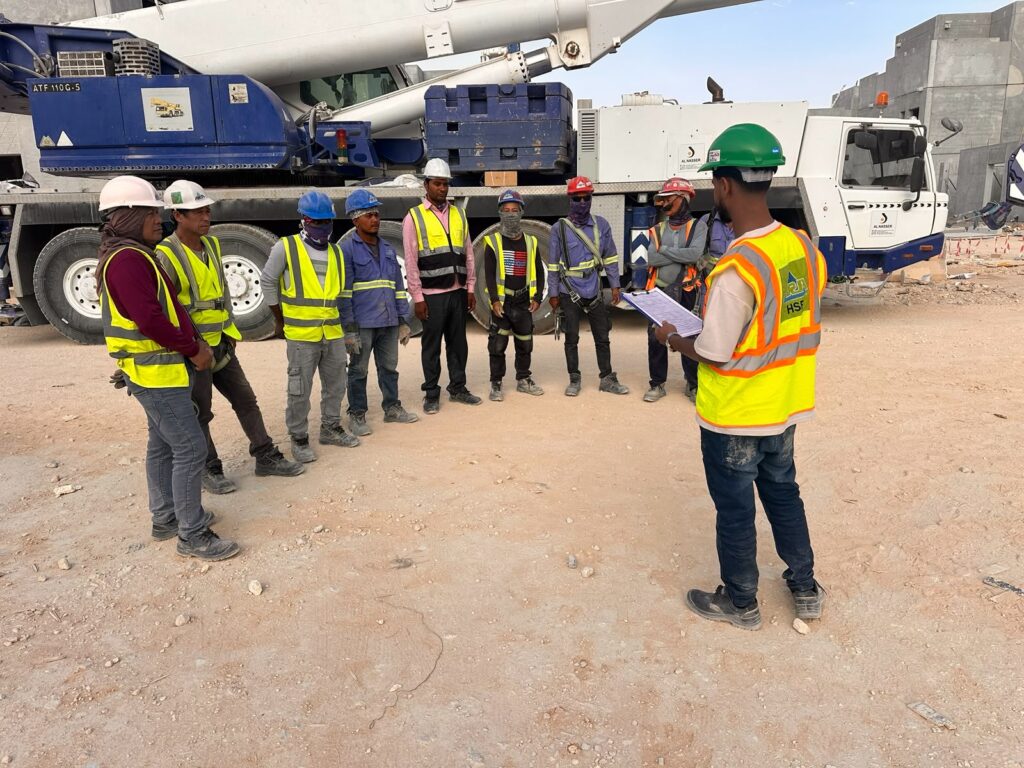
Mohammad Abdullah Hashrouf promotes this principle through workforce communication and practical safety awareness. Toolbox Talks (TBTs) are an important part of this process. Short and focused discussions before work begins allow workers to understand the hazards associated with their activities and the precautions they should take.
Topics such as personal protective equipment, manlift operation, crane positioning, lifting operations, exclusion zones, fire prevention, welding and grinding safety, and general workplace hazards can provide workers with practical information that can immediately be applied at the worksite.
The objective is not simply to deliver safety instructions but to encourage workers to recognize hazards themselves and take responsibility for controlling them.
Hazard Identification and Risk Management
Hazard identification and risk management are fundamental elements of occupational health and safety. Mohammad’s professional role involves recognizing unsafe conditions and helping ensure that appropriate controls are implemented.
Before work starts, hazards should be considered systematically. This may involve reviewing the work method, identifying potential sources of injury or exposure, assessing the likelihood and severity of possible consequences, and determining appropriate control measures.
The hierarchy of controls provides an important framework for managing hazards. Where possible, hazards should be eliminated or reduced at their source. Engineering controls, administrative controls, and appropriate personal protective equipment can then be applied as necessary.
On active worksites, conditions can change rapidly. For this reason, safety professionals must remain alert to changes in work activities, weather, equipment, personnel, and site conditions. Continuous monitoring and communication help ensure that controls remain effective throughout the work process.
Lifting and Equipment Safety
Lifting operations are among the activities requiring careful planning and control. Cranes, lifting accessories, suspended loads, and moving equipment can create significant risks when proper procedures are not followed.
Mohammad Abdullah Hashrouf emphasizes important principles such as suitable ground conditions, correct crane positioning, proper outrigger support, controlled lifting areas, and effective exclusion zones. Personnel should remain clear of suspended loads and designated danger areas, while unauthorized access should be prevented.
Similarly, mobile elevated work platforms and manlifts require proper inspection, competent operation, appropriate personal protective equipment, and awareness of surrounding hazards. Workers using access equipment should understand the manufacturer’s requirements and site-specific procedures.
These practices demonstrate the importance of combining equipment safety with human awareness. Even properly maintained equipment can become hazardous when operated incorrectly or used in unsuitable conditions.
Personal Protective Equipment
Personal Protective Equipment (PPE) is another important component of Mohammad’s safety focus. PPE provides workers with protection against specific workplace hazards when risks cannot be completely eliminated through other controls.
Depending on the activity, PPE may include safety helmets, safety footwear, high-visibility clothing, gloves, eye protection, hearing protection, respiratory protection, fall protection equipment, and specialized PPE for welding or grinding.
However, PPE should not be viewed as the only safety measure. Workers must first understand the hazards associated with their tasks and follow established safe work practices. Correct PPE selection, proper use, inspection, and maintenance are essential to ensure that protective equipment performs its intended function.
Training and Safety Communication
Effective communication is one of the most important skills for an occupational health and safety professional. Safety procedures are only effective when workers understand them and can apply them correctly.
Mohammad Abdullah Hashrouf supports safety communication through toolbox talks, workforce briefings, safety observations, and direct interaction with employees at the worksite. Clear communication helps workers understand why a particular control is necessary rather than simply telling them what to do.
A good safety briefing should be practical, relevant to the day’s activities, and easy for workers to understand. It should also provide an opportunity for workers to raise concerns or identify hazards that may not have been recognized previously.
This two-way approach can strengthen trust between workers and the safety team and encourage employees to report unsafe conditions before they result in incidents.
Building a Positive Safety Culture
Safety culture develops through daily actions and attitudes. It is influenced by how organizations respond to hazards, how supervisors communicate expectations, and how workers participate in safety activities.
Mohammad’s professional philosophy supports a proactive safety culture in which employees are encouraged to take ownership of their own safety and the safety of their colleagues. Reporting hazards, following procedures, using appropriate PPE, maintaining good housekeeping, and stopping unsafe work are all important elements of this culture.
A positive safety environment also recognizes that safety improvement is a continuous process. Lessons learned from inspections, observations, incidents, and workforce feedback can be used to improve procedures and prevent similar problems in the future.
Professional Values
Mohammad Abdullah Hashrouf’s professional approach is built around responsibility, vigilance, communication, teamwork, and continuous improvement. Occupational health and safety professionals often work with people from different backgrounds, trades, and levels of experience. The ability to communicate respectfully and clearly is therefore essential.
His approach emphasizes prevention rather than waiting for an incident to occur. By identifying hazards early, communicating expectations, monitoring controls, and encouraging safe behavior, safety professionals can contribute significantly to operational efficiency and worker well-being.
Conclusion
Mohammad Abdullah Hashrouf is an Occupational Health and Safety Specialist focused on supporting safe and responsible workplace practices. His professional interests encompass hazard identification, risk control, site inspections, toolbox talks, PPE, lifting operations, equipment safety, workforce communication, and safety culture development.
His work reflects an important principle of occupational health and safety: preventing incidents begins before the work starts. Through planning, communication, supervision, and continuous improvement, organizations can reduce workplace risks while creating an environment where employees understand that safety is everyone’s responsibility.
As workplace environments continue to evolve, the role of safety professionals remains essential. Professionals such as Mohammad Abdullah Hashrouf contribute by connecting safety requirements with practical site operations and helping workers make informed, safe decisions every day.